

Planning Bus Refurbishments to Meet Canadian Accessibility Standards
Planning Bus Refurbishments to Meet Canadian Accessibility Standards
If you are planning ahead for bus refurbishment to meet Canadian accessibility standards, there are several overlapping pieces of legislation, federal and provincial, that govern what is needed. New buses need to meet the current standards immediately, but older buses and existing fleets have time and different deadlines to phase in the refurbishment depending on bus sizes, types, and fleet size. Navigating these requirements can be complex, but it is essential for providing equitable transportation across Canada.
The Accessible Transportation for Persons with Disabilities Regulations (ATPDR) outlines specific technical requirements that bus carriers must follow. In today’s blog, we want to give you a brief idea of what is needed to bring your fleet up to code, focusing on the key areas of refurbishment that will ensure your vehicles are safe and accessible for all passengers.
Upgrading Lighting and Visual Contrast for Better Visibility
There needs to be adequate lighting and sufficient contrast for people to easily see and read signs. When most people think of accessibility, they think of those who have difficulty walking. However, accessibility standards also take into account those who may have other less obvious handicaps such as vision or hearing impairment.
According to the ATPDR, any stairs used to board or disembark from a bus, as well as interior stairs, must be equipped with lighting that accentuates the steps and handrails. This ensures that passengers with low vision can safely navigate elevation changes within the vehicle. Furthermore, all grab bars, handholds, and stanchions must be colour-contrasted with their background to make them easily identifiable.
When planning your refurbishment, consider how lighting and contrast work together to guide passengers. Key visual upgrades should include:
- Installing high-contrast strips around the perimeter of window emergency exits
- Ensuring all call buttons are colour-contrasted with their background
- Adding tactile attention indicator surfaces at the top of all stairs
- Using glare-free surfaces for all interior signage to prevent visual distortion
By focusing on these visual elements, you create an environment where all passengers can navigate the bus confidently and independently.
Ensuring Operating Controls Are Reachable and Usable
Stop request controls need to be easy to see and easy to reach at appropriate heights. The ATPDR mandates that passenger seats on a bus must be equipped with call buttons that are tactilely discernible and operable using minimal force. This ensures that passengers with limited dexterity or upper body strength can easily signal the driver when they need to disembark.
Beyond call buttons, all operating controls intended for passenger use must meet strict accessibility guidelines. This includes controls in the washroom, such as automated flush controls, faucets, and soap dispensers, all of which must be operable with one hand in a closed-fist position. The goal is to eliminate the need for tight grasping, pinching, or twisting of the wrist.
When retrofitting older buses, replacing outdated controls is often one of the most straightforward yet impactful upgrades you can make. By installing modern, low-force controls, you significantly improve the passenger experience for individuals with mobility or dexterity challenges.
Improving Communication Systems for All Passengers
There needs to be good visual displays and adequate audible announcements of pertinent information showing routes and stops. The ATPDR requires that signage on a bus must indicate any services, facilities, amenities, or equipment that are offered, as well as the direction to follow in order to access them. This signage must be positioned to avoid shadow areas and glare.
For electronic signage, the regulations specify that letters, numbers, symbols, and pictographs must slowly scroll across the screen and be colour-contrasted with their background. Notably, the regulations prohibit the use of red text on a black background, as this combination is notoriously difficult for individuals with certain types of colour blindness to read.
To ensure comprehensive communication, your refurbishment plan should incorporate:
- Electronic displays that provide clear, scrolling text for route information
- High-quality audio systems for clear, audible stop announcements
- Tactile and Braille signage identifying emergency exits and washroom facilities
- Passenger safety features cards available in large print and Braille
By providing information in multiple formats, including visual, audible, and tactile, you ensure that no passenger misses critical route or safety information.
Configuring Seating for Maximum Accessibility and Comfort
There should be special seating for the handicapped near the front and clearly marked. Near this seating area should be adequate space and grab bars for stability in maneuvering around. The ATPDR specifically requires that the first row of passenger seats on each side of a bus must be designated as priority seats for persons with disabilities, complete with clear signage.
In addition to priority seating, the regulations mandate that all aisle and middle passenger seats must be equipped with movable armrests, and all aisle seats must have handholds on the back. This provides crucial support for passengers as they move through the bus. Furthermore, buses must be equipped with tactile row markers, in raised characters and Braille, installed on the sides of passenger seats.
When evaluating seating configurations, it is also essential to account for mobility aid spaces. A bus must have at least two mobility aid spaces, each with a clear floor area of at least 1,220 mm by 760 mm. Ensuring these spaces are properly integrated into the seating layout is a critical component of any refurbishment project.
Meeting the Requirements for Wheelchair-Accessible Washrooms
For long-distance buses, washroom accessibility is a major component of the ATPDR. A wheelchair-accessible washroom on a bus must have a door or other opening that has sufficient space in front of it and is wide enough to allow the entry of a person using a wheelchair. There must also be sufficient space inside to allow a person, with assistance, to transfer to and from a wheelchair and the toilet.
The regulations also specify that the washroom must provide sufficient privacy, including the use of retractable curtains or walls, to allow a support person or service dog to remain inside. Faucets must be positioned to be easily usable by a person using a wheelchair, and grab bars must be capable of supporting a minimum weight of 113.4 kg.
Key upgrades for washroom accessibility include:
- Installing automated flush controls and water activation motion sensors
- Ensuring all doors, locks, and soap dispensers are operable using minimal force
- Adding at least one call button that is colour-contrasted and identified by Braille
- Mounting grab bars that are rounded, slip-resistant, and free of sharp elements
By upgrading these facilities, you ensure that all passengers can travel comfortably and with dignity on longer routes.
Modernizing Boarding Systems for Safe Entry and Exit
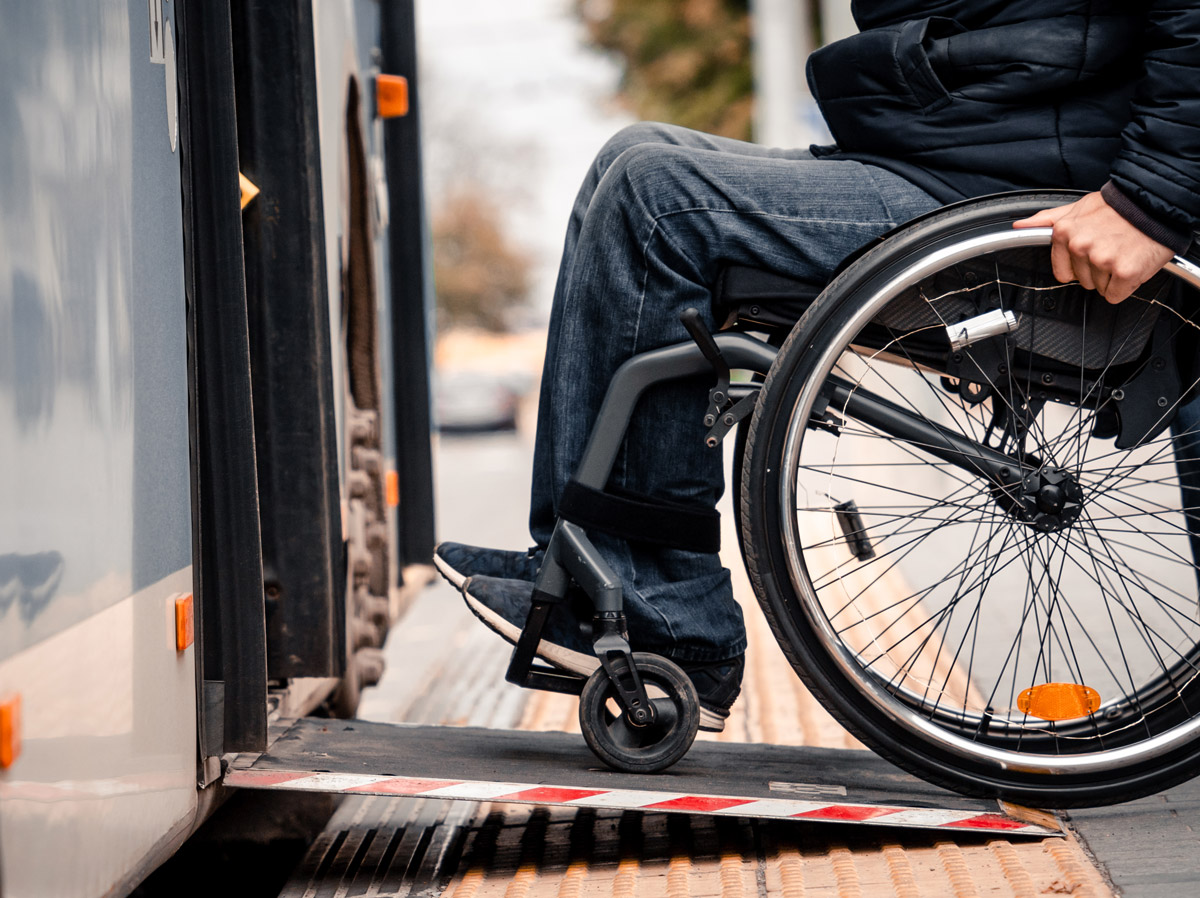
There needs to be low-floor designs or kneeling or wheelchair lifts/ramps for accessibility with capacity for at least 600 pounds. The ATPDR is very clear on boarding requirements: if a bus makes a stop at any place where passengers are permitted to board and disembark, and level boarding is not available, the bus must be equipped with a lift, ramp, or bridge plate.
For older buses that were not originally designed with low floors, retrofitting a reliable wheelchair lift is often the most practical solution. These lifts must be robust, easy for the driver to operate, and capable of safely handling heavy motorized wheelchairs and scooters. Additionally, any stairs used for boarding must have handrails on both sides, located at a uniform height of 860 mm to 920 mm.
To ensure your boarding systems meet the latest standards, focus on:
- Installing heavy-duty wheelchair lifts or ramps at the primary boarding doors
- Equipping all boarding stairs with dual handrails and tactile attention indicators
- Ensuring the baggage compartment can store at least two mobility aids
- Regularly maintaining all lifts and ramps to ensure they are in good working order
Safe and efficient boarding is the foundation of accessible transportation. Upgrading these systems should be a top priority during any retrofitting project.
Navigating the Complexities of Compliance and Refurbishment
What is key to understand is that accessibility means different things to people with different types of handicaps, and the bus has to allow access to many different handicapped individuals. The ATPDR covers everything from the diameter of grab bars to the specific dimensions of a wheelchair-accessible washroom. Rules are complex, and it would be good business to consult experts before starting to spend money on refurbishment to make sure you are in compliance with your particular province’s or territory’s requirements.
Dynamic Specialty Vehicles has been supplying and servicing mid-sized buses for over 30 years. With long-term contracts with demanding clients like BC Ambulance and BC Transit, Dynamic Specialty Vehicles knows how to keep their clients safe and their buses running smoothly. We understand the intricacies of the Accessible Transportation for Persons with Disabilities Regulations and can help you plan a refurbishment strategy that meets all federal and provincial standards.
Whether you are looking to upgrade a single vehicle or overhaul an entire fleet, our team has the expertise to guide you through the process. We can help you identify the most cost-effective solutions for meeting the ATPDR requirements, from simple lighting upgrades to complex wheelchair lift installations. Our goal is to help you provide safe, accessible, and reliable transportation for all of your passengers.
If you have any questions about this article or would like further information about accessible buses, accessibility standards, and our parts and service department, please call us on our Toll-Free number, (888) 416-9333. We are here to help you navigate the refurbishment process and ensure your fleet is ready to serve all Canadians.